

MSP Insights
MSP Valuation

Reed Watne
|
Understanding MSP Valuations
EBITDA Multiples, Financial Targets, and the Path to Becoming a Platform
Valuation is a constant topic of interest for Managed Service Providers. Owners want to know what their business is worth today and what levers will increase that value tomorrow. The market has matured, private equity interest remains strong, and strategic buyers are getting more selective. This creates real opportunities for MSPs that understand their numbers and can present a predictable, profitable business.
This guide breaks down what an optimal MSP financial model looks like, how EBITDA multiples vary by size, and why the industry is seeing such a strong push toward becoming a “platform” provider.
The Optimal MSP Financial Profile
The most valuable MSPs share the same basic financial structure. While every business is different, the following rule of thumb describes a healthy service provider.
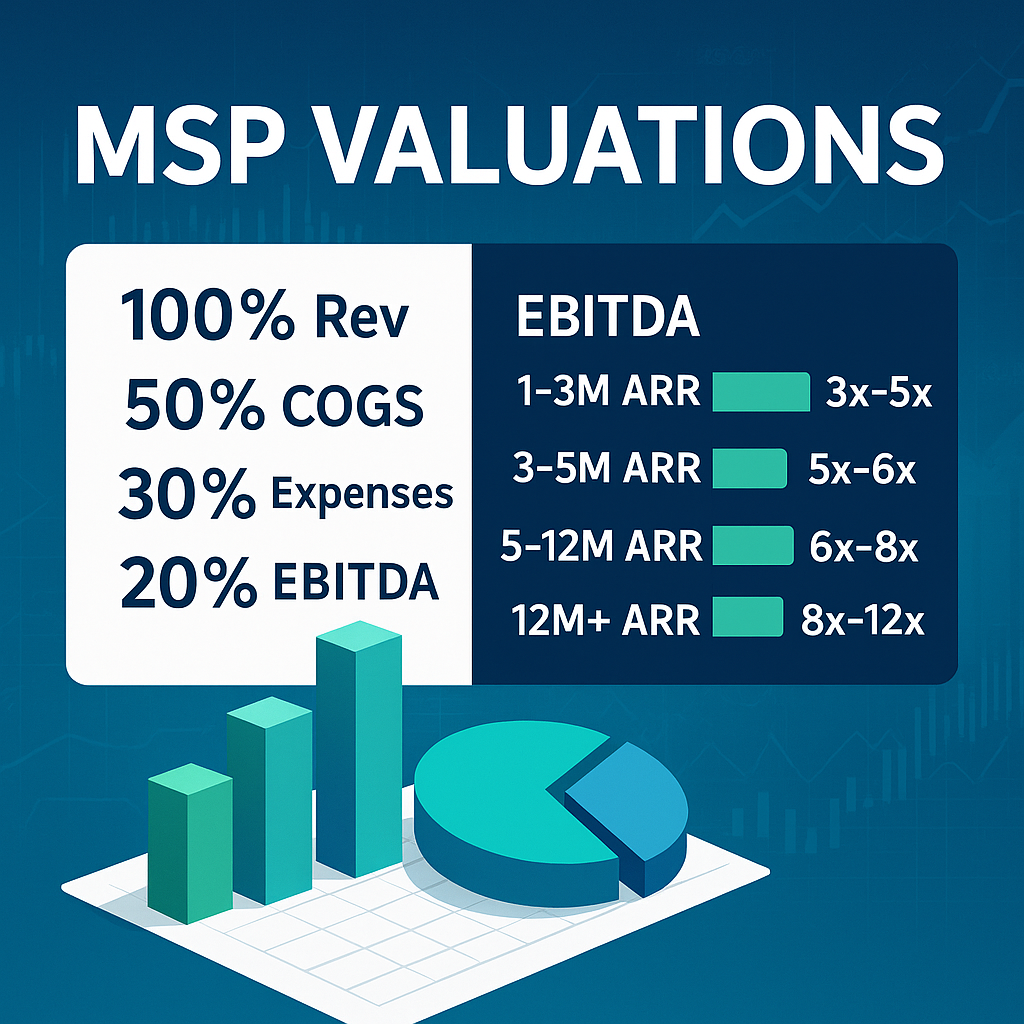
100 percent revenue
50 percent cost of goods sold (COGS)
30 percent operating expenses (SG and A)
20 percent EBITDA
This structure creates strong, repeatable profitability while leaving room for growth investments.
Example Financial Model
If an MSP generates one million dollars in recurring revenue, the simplified breakdown looks like this:
- Revenue: 1,000,000
- COGS: 500,000
- SG and A: 300,000
- EBITDA: 200,000
This level of profitability is critical because almost all buyers value MSPs based on an EBITDA multiple. The stronger and more predictable the EBITDA, the stronger the valuation.
EBITDA Multiples by MSP Size
MSP valuations scale with revenue size. Larger providers tend to be more stable, more diversified, more process driven, and better positioned for platform level integrations. This lower perceived risk results in higher multiples.
Below is a general range of multiples for MSPs that maintain roughly twenty percent EBITDA. These are aggregated from current market activity and advisory firms across the industry.
1 to 3 million ARR
Typical EBITDA Multiple: 3x to 5x
Smaller MSPs often rely heavily on owner involvement and may have higher customer concentration. Buyers discount these risks.
3 to 5 million ARR
Typical EBITDA Multiple: 5x to 6x
At this stage the MSP tends to have a small management layer, stronger financial reporting, and more defined processes.
5 to 12 million ARR
Typical EBITDA Multiple: 6x to 8x
These businesses show scale, predictable revenue, and deeper teams. They are large enough to attract interest from regional operators and financial buyers.
12 million ARR and above
Typical EBITDA Multiple: 8x to 12x
This is the level where buyers begin to consider an MSP a platform business. Platform companies are the anchors of acquisition strategies. They receive premium valuations because they serve as the operational core for future bolt-on acquisitions.
Why The Market Is Chasing Platform Status
There is a growing trend in the MSP community to acquire revenue in order to reach the platform threshold. The logic is simple. A larger ARR base commands a higher multiple, which means the same dollar of EBITDA becomes significantly more valuable.
However, size alone is not enough.
A true platform requires a unique differentiator that separates it from the hundreds of other MSPs chasing the same strategy. Without differentiation, a roll-up becomes expensive, risky, and difficult to integrate.
What Makes a Real Platform
Examples of differentiators include:
- A proprietary service framework or automation layer
- Deep specialization in a vertical market
- A strong internal sales engine
- A unified, modern tech stack
- AI driven workflows and digital worker capabilities
- Operational maturity that supports integration at scale
Platforms are not defined only by revenue. They are defined by their ability to absorb other companies, standardize operations, and grow at scale.
The Risk of Growth Without Differentiation
Some MSP owners pursue aggressive acquisition strategies to reach the next valuation tier, but this approach comes with real risks:
- Integration challenges reduce profitability
- Cultural mismatches slow growth
- Too many toolsets hurt efficiency
- Customer experience declines
- The business becomes a loose collection of companies rather than a unified platform
Buyers recognize this risk. They discount any MSP that has grown without alignment or operational discipline.
Key Takeaways for MSP Owners
If your goal is to maximize valuation, the path is clear.
1. Build toward twenty percent EBITDA
This is the benchmark for healthy, high performing MSPs.
2. Reduce risk across the business
Lower concentration, modernize systems, document workflows, and strengthen financial reporting.
3. Understand your ARR tier
Your size determines your likely multiple. Do not assume you can jump tiers without fixing structure.
4. Do not chase platform valuation without a real differentiator
A platform is created by capability, not just by revenue.
5. Prepare now for the next era of MSP operations
AI, automation, and digital workers will reshape service delivery and profitability. Early adopters will gain valuation advantages.
Check out our clickable prototype.
Final Thoughts
MSP valuations reward companies that are predictable, profitable, and scalable. If you can show strong EBITDA, disciplined operations, a refined service model, and a clear differentiator, you will stand out in a crowded market and attract premium interest from buyers.